
Together We are Greener
We Need Your Help
GreenWayz is just beginning its mission, but the need is vast, and we cannot reach every school on our own. That’s why we’re calling on teachers and schools to join us in addressing the challenges facing our environment. By incorporating Environmental Education into their classrooms, educators can play a crucial role in equipping the next generation with the knowledge and tools to create a more sustainable future. Together, we can amplify the impact and make meaningful strides toward protecting our planet.


It's Simple!
From our time at the schools and working with the students, we have learned that teaching Environmental Science doesn't need to be complicated . . . it's actually very simple! Especially with the younger kids, elaborate lessons and PowerPoints tend to lose the attention and interest of young students. Hands-on interactions and having fun with the different aspects of Environmental Science works best!
Adding it to Your Curriculum
Environmental Science at times is seen as an individual course, but it doesn't always need to be. Environmental Science includes topics that range across many subjects including: economics, history, ecology, geology, biology, chemistry, and more. When we say, "add Environmental Science to your program", it doesn't necessarily have to be its own separate class. Rather, finding ways to incorporate it gets the job done. For example, in history class, celebrate earth day/week!

Some of Our Lessons
It can be difficult to come up with new lesson plans to teach about the environment. The lessons need to have the right balance of teaching material and activities to engage the kids and test how much they are learning. Below are a few of the activities that we did with the students that they liked a lot that can be used in your future lessons!
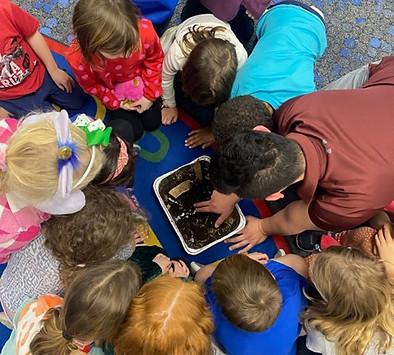
Compost Exploration
After our composting lesson, we wanted to show what real compost looks like along with the components that go into it. For this activity, we brought in a sample of our school's compost (if you do not have one, you can always grab soil and some of the components that go into compost) and let the students dig through it hands-on! Each time they found one of the components of the compost in it, we had them identify what it was (green vs. brown). We even snuck in some non-compostables to see if they would catch them!
Biome Trivia
After teaching the students about the different biomes around the world and how humans have had an impact on each, we split them up into three teams for trivia! Each slide had a different continent and four pictures of different biomes: only one of them belonged to that continent. The first team to raise their hand and guess which was the correct biome got a point ... a bonus point was given to a student who could name an impact humans are having on that biome. Most points at the end win!


Recycling Sorting
Prior to teaching about the proper ways to recycle, including what can and cannot be recycled, we split the students up into four different teams: each team was given a brown bag full of different recyclables and non-recyclables. The students attempted to sort the materials into groups of recyclable and non-recyclable. We wrote down each team's score (how many they sorted correctly out of 20 total items) BUT made sure not to tell them which materials were sorted correctly or incorrectly. Then, we taught them the proper ways to recycle along with what can and cannot be recycled. Afterward, we had them repeat the activity. We recalculated the scores at the end and whichever team had the highest score won! The idea is that the score is low in the beginning (so don't be worried) but after learning, the scores shoot up!